
Turning equity commitments into measurable action in maternity care
Inequities in Maternal Policy and Care Tracking (IMPACT) is a practical framework co-developed by White Ribbon Alliance UK and the University of Southampton to help policymakers, the NHS, and VCFSEs identify and address structural inequities in maternal health policy and care.
We’re building tools that support organisations to take meaningful action towards creating equity in policy development, service design, and commissioning.
Why IMPACT exists
Maternal and neonatal health inequities persist in the UK.
Black women are nearly three times more likely to die during or shortly after pregnancy than White women.
Women living in the most deprived areas face significantly worse outcomes.
Groups such as neurodivergent people, young parents, migrants, and military-connected families are often missing from national data and policy.
Most national maternity policies acknowledge inequalities.
Acknowledgment is not the same as action.
Policies often:
Refer to disparities without setting measurable targets
Lack clear accountability for closing gaps
Do not ringfence funding for equity-focused change
Fail to monitor whether inequities are reducing
As a result, inequities are recognised but not systematically addressed. Advocacy has raised awareness. It has not consistently changed how systems make decisions.
IMPACT was developed to close that gap.
It provides an effective and evidence-based way to:
Examine policy and service design through an equity lens
Make visible where systems, policies, or practices disadvantage people so that practical improvements can be identified
Embed equity into commissioning and planning
Move from commitment to measurable action
IMPACT exists because equity needs practical tools, not just statements.
What does IMPACT do?
IMPACT is a structured assessment process.
It brings a consistent set of dimensions and criteria to the review of maternity policy, strategy, and service design.
Rather than relying on general statements about equality, IMPACT supports teams to examine:
How inequities are defined and evidenced
Which populations are explicitly considered
Whether proposed actions are specific, measurable and resourced
How accountability is assigned
Whether monitoring arrangements are capable of tracking change
The framework can be applied to existing policy, to new service design, or to transformation programmes already underway.
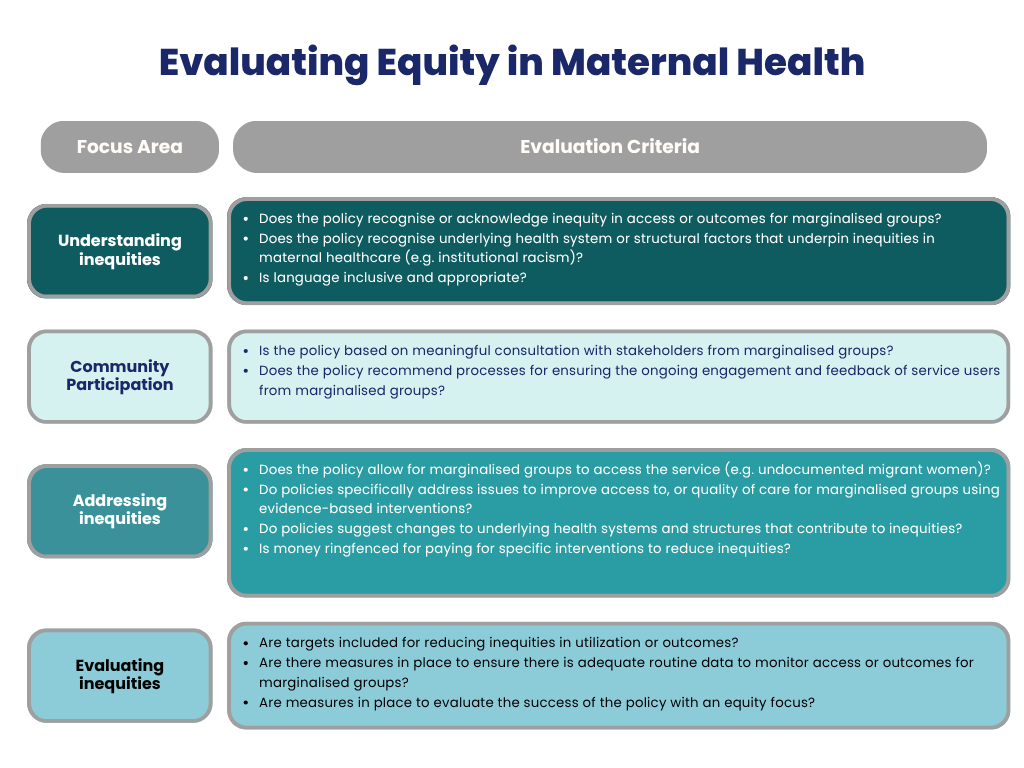
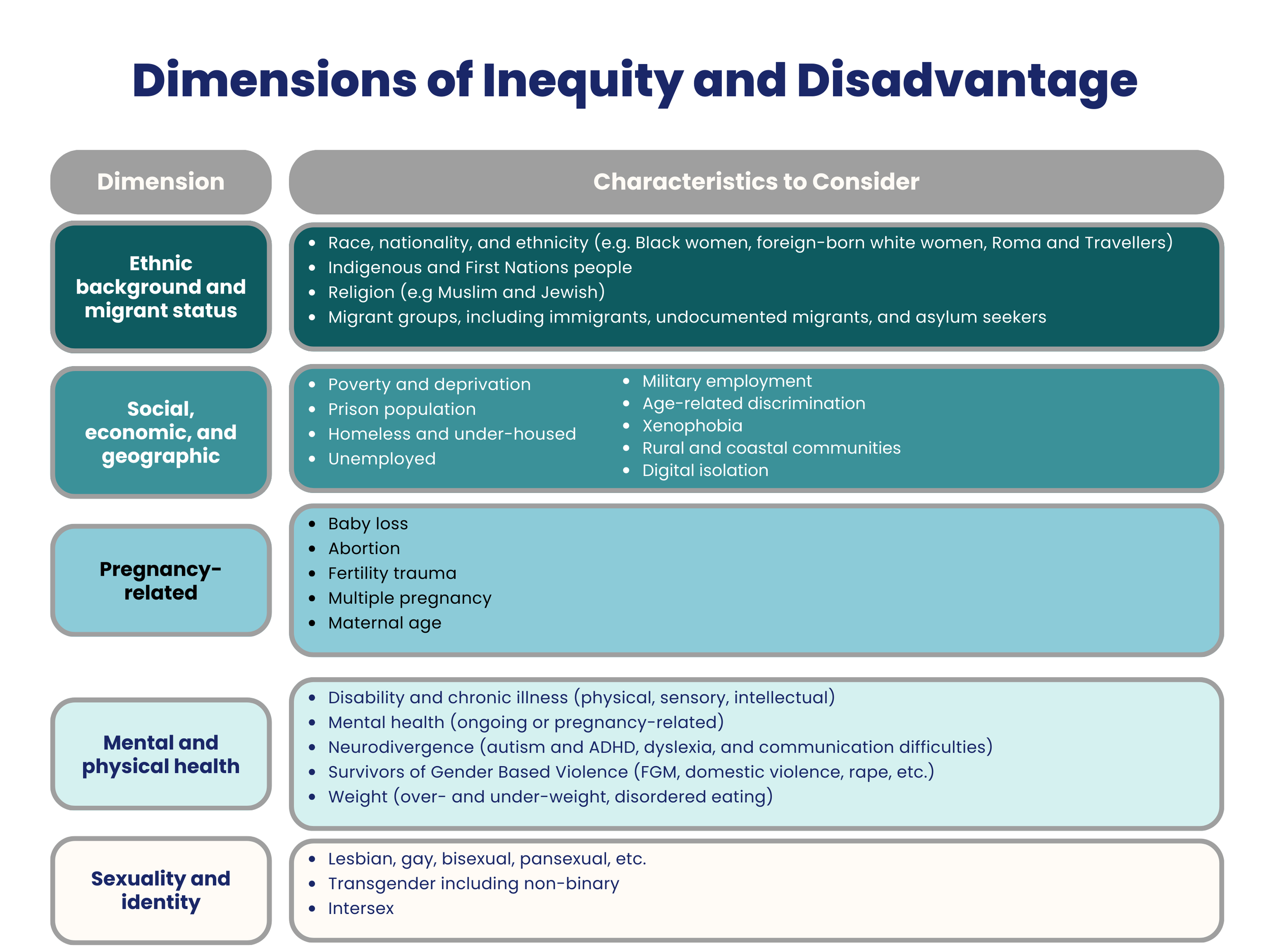
The graphics above outline the core evaluation dimensions and focus areas that structure this assessment. Click here to view them in PDF format.
Where IMPACT is being used now (2026)
IMPACT is moving from development into real-world application and refinement. Current work includes:
NHS Race and Health Observatory (RHO): working together to evidence how IMPACT can be used to support equity-focused review of maternity policies and strategies, and to strengthen decision-making through a racial and ethnic equity lens.
Neurodivergent Equity for Women and Birthing People: In January 2026, in collaboration with ND Birth CIC and the University of Southampton, we released “Advancing Equity in Neurodivergent Maternal Care through the IMPACT Framework” , a report showing how IMPACT can be applied in real-world settings.
Parliamentary engagement: sharing IMPACT briefings (such as our Neurodivergent Equity brief), with parliamentarians and supporting discussions linked to the All-Party Parliamentary Group on Maternity Services, alongside advocacy partners.
NHS Lincolnshire ICB: exploring how IMPACT can be applied to promote equitable access and experience for military-connected families and other underserved communities, with learning designed to support wider adoption.
We will publish learning and tools from this work as it becomes available, including summaries of what has been implemented, what has changed, and what it suggests for policy and commissioning.
Want to get involved?
To explore opportunities, contact Sarah Neal, Professor of Global Health at University of Southampton and Leah Lewin or Julie Boddy, Co-CEOs at White Ribbon Alliance UK.